
After the First Bite at Sen Vegan
An introduction to Vietnamese vegetarian culinary. A rare gem in the middle of Pho Mile, Shoreditch

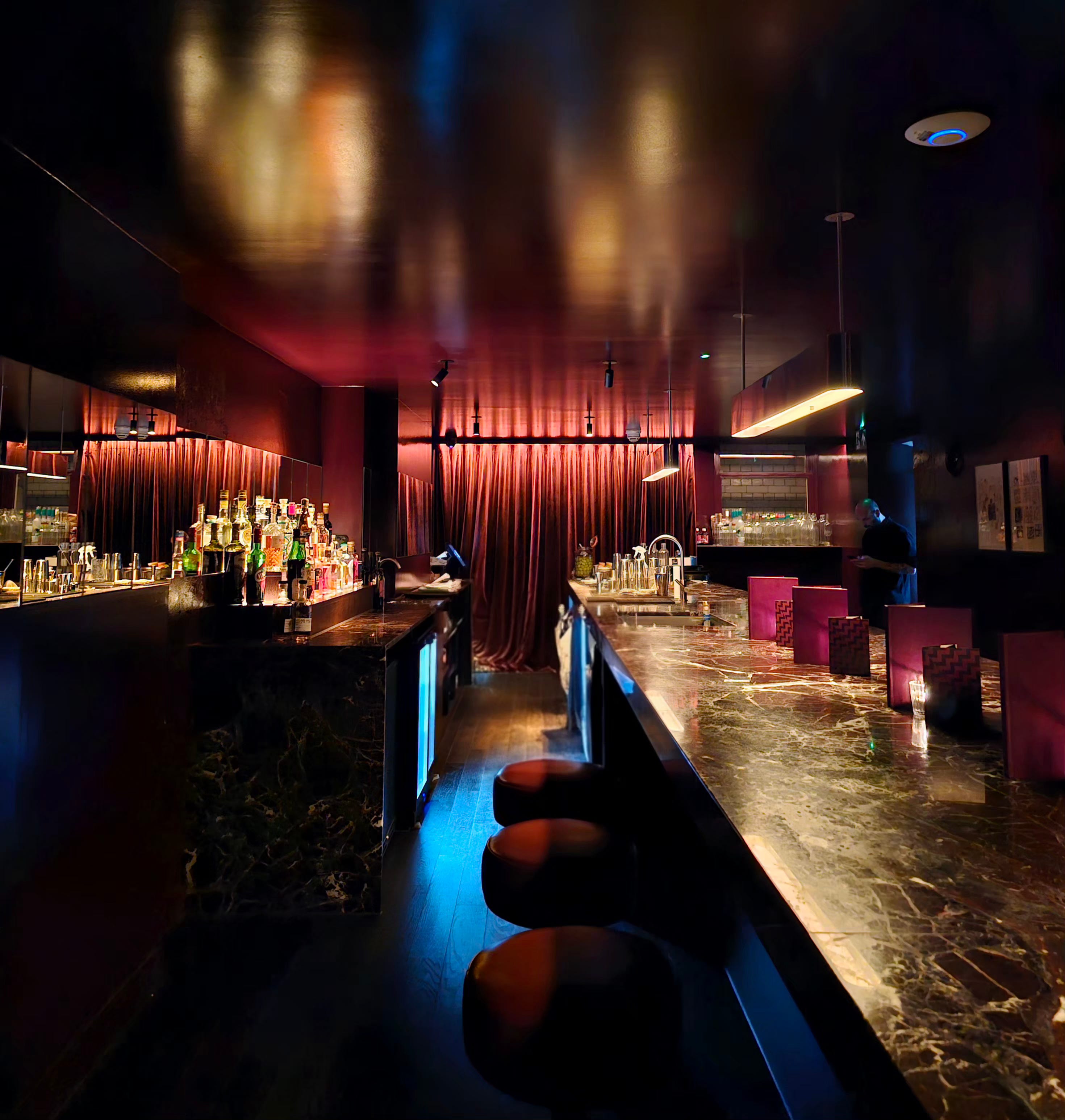
Before you think I have discovered a hidden low-fi Vietnamese bar in London, I have not. Let me first take you to Bar Lina, hidden in the basement of Lina Store, a well-known pasta chain with locations across the city. If Lina Store gives a family-friendly sense, Bar Lina is quite the opposite.
Entering the room, you are welcomed by the sensory, herby fragrance (I can’t speak for other locations, but I was at Shoreditch). The room is decorated with a red theme and dimmed lights. An intimate, cosy space where you catch up with your friends or lovers over glasses of cocktails. The options are not as diverse as those of other bars, but they provide enough choices to encourage you to stay longer, especially with the complimentary crisps and olives. I’m not a drinker, so I can’t speak on the quality, but my friends rated them. As we were getting closer to the next reservation, we had to wrap up and thank the lovely host.
Now we’re getting to the real deal. Because the real reason we were in Shoreditch wasn’t cocktails - it was a vegetarian Vietnamese dinner I’d been excited (and slightly nervous) to introduce to my friends. As both of my companions are non-Viet, I made a reservation at Sen Vegan on Pho Mile (for those not living in London, Pho Mile in Shoreditch is known for its high concentration of authentic, affordable Vietnamese restaurants).
If you think you know Vietnamese food well with phở, bún bò Huế, bánh mì, or bánh xèo, then our vegetarian food will make you rethink whether you’ve tried them all. Our cuisine is made up of a long-standing history, accumulated through generations of wars and upheavals, and rich traditions carried carefully from one family table to the next - because food, more than almost anything else, is a portrait of a culture (as I wrote in my previous post).
Generally, the first impression of Vietnamese cuisine is that we’re carb and meat eaters. Like many Asian cuisines, rice is the main staple in our daily lives. It’s the kind of food people could rely on for energy through scarcity and conflict. Meat finds its way into plenty of dishes - pork, chicken, river fish - but that’s exactly why the vegetarian side surprises people: it’s not an afterthought.
The menu is a good introduction to our cuisine with many typical dishes and a few others that you can easily find in a home meal. As the guide of the show, we followed my recommendations and chose to try Banh Xeo (Crispy Pancake) and Lá Lốt (Grilled Betel Leaf).
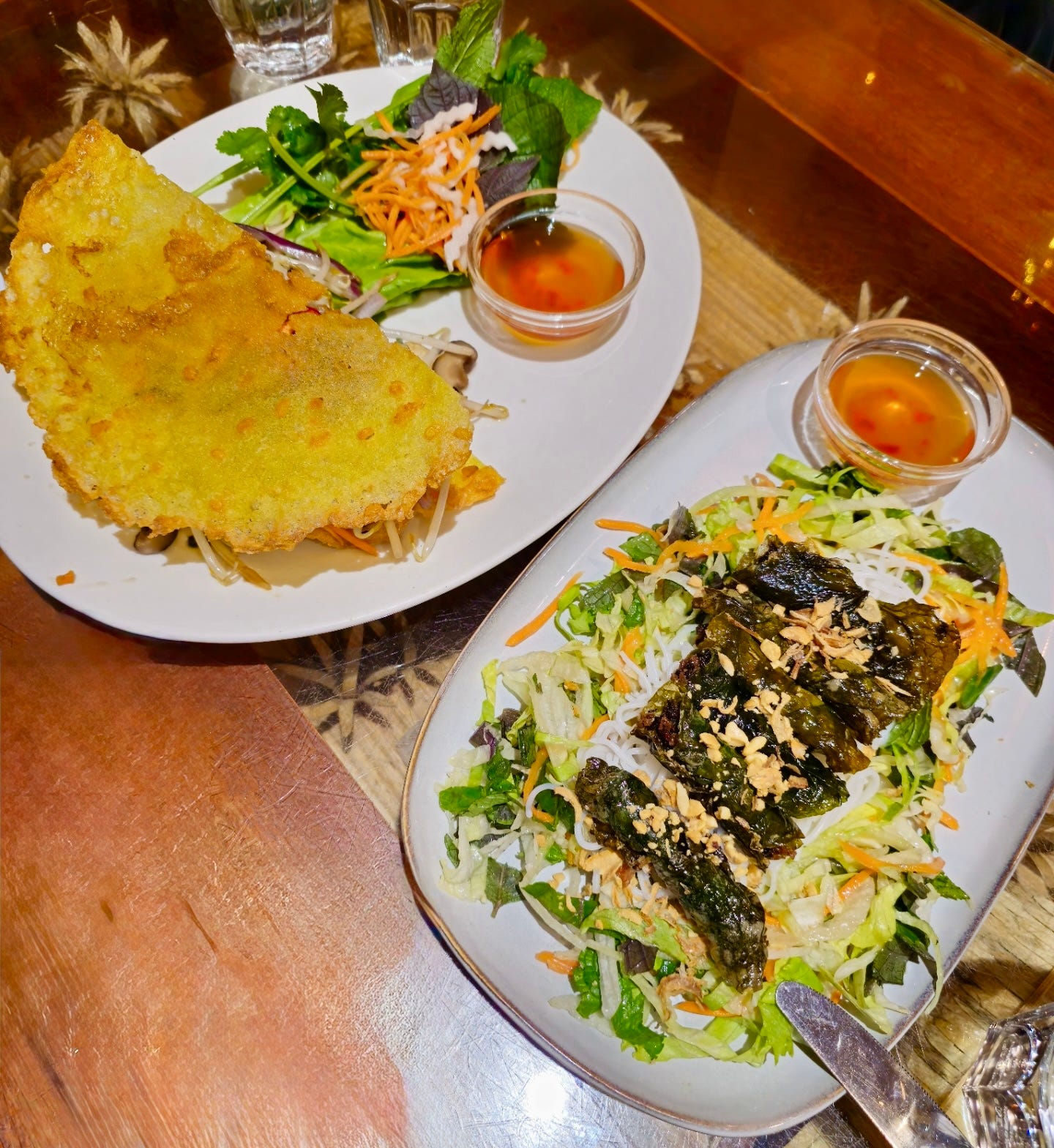
1. Bánh Xèo (on the left)
Cracking through the crispy, golden layer is the harmony of different ingredients. You may have to look closely to see what's there.
They have done well with the turmeric mix. Maybe it was the secret ratios and the skilful technique to cook the batter that I could never master, the crispiness of the crepes tactically enhanced the flavours of all fillings inside. Tofu, beansprouts, onion, mung beans, carrots, and mushrooms were stir fried with some seasoning - just light enough to fuse perfectly as you dip them into the sweet and sour sauces.
If you don’t mind getting your hands dirty, you can also wrap them with a slice of lettuce and other herbs to bring in the freshness that balances out the savoury, tangy taste of the main dish.
Lá Lốt (on the right)
Usually, you’d find beef in the non-veg version. Here, the stars of the show are tofu, black fungus, and shiitake mushrooms, all wrapped in betel leaves.
Once grilled, the betel leaves release a distinctive fragrance - savoury, slightly peppery, and herbaceous. As you take a bite of the rice noodles and dip them into the sauce, you’re instantly met with a smoky depth that elevates the fillings inside. The crunch of the crispy edges softens the moment it meets the sauce, allowing the sweet-and-sour flavours to seep through the proteins.
Beef betel leaves are mom’s favourite. Funnily enough, I hated them when I was younger. Maybe it was the slight bitterness of the leaves that my still-developing palate couldn’t quite accept. As I grew older, and especially being away from home, I’ve started to appreciate the traditional dishes I once missed out on while living in Vietnam. I guess that’s something to thank adulthood for: finally letting me fall in love with these authentic flavours, hehe.
As we concluded the starters with our expectations exceeded, I was happy it was the perfect start. Moving on to the mains, we ordered one dish each, as our appetite grew after the long dialogues about everything and anything. Good food is the perfect pause - an easy bridge that keeps the conversation flowing after every bite.
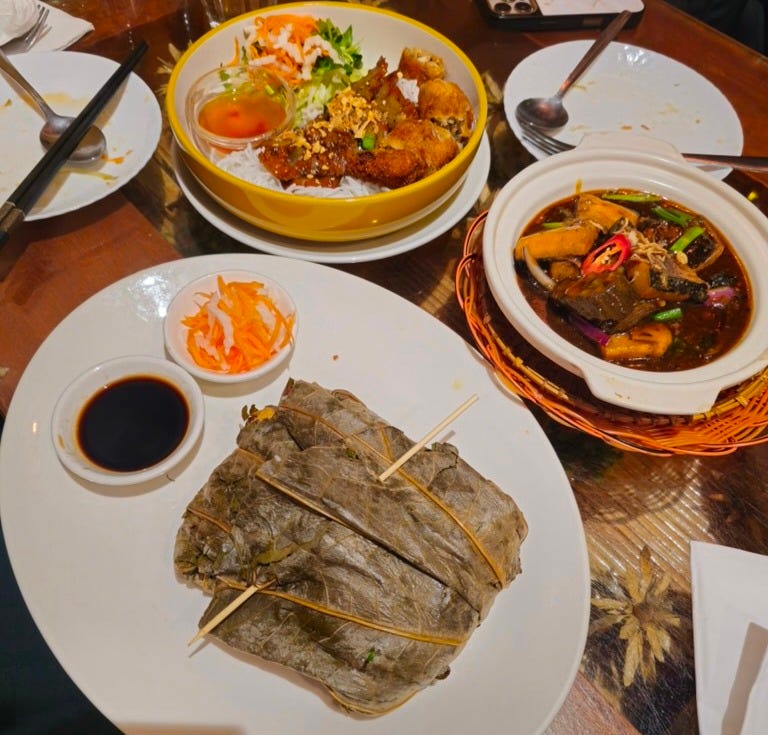
What you are seeing above:
Bún Chả Tổng Thống (Presidential Bun Cha) (on the top left corner)
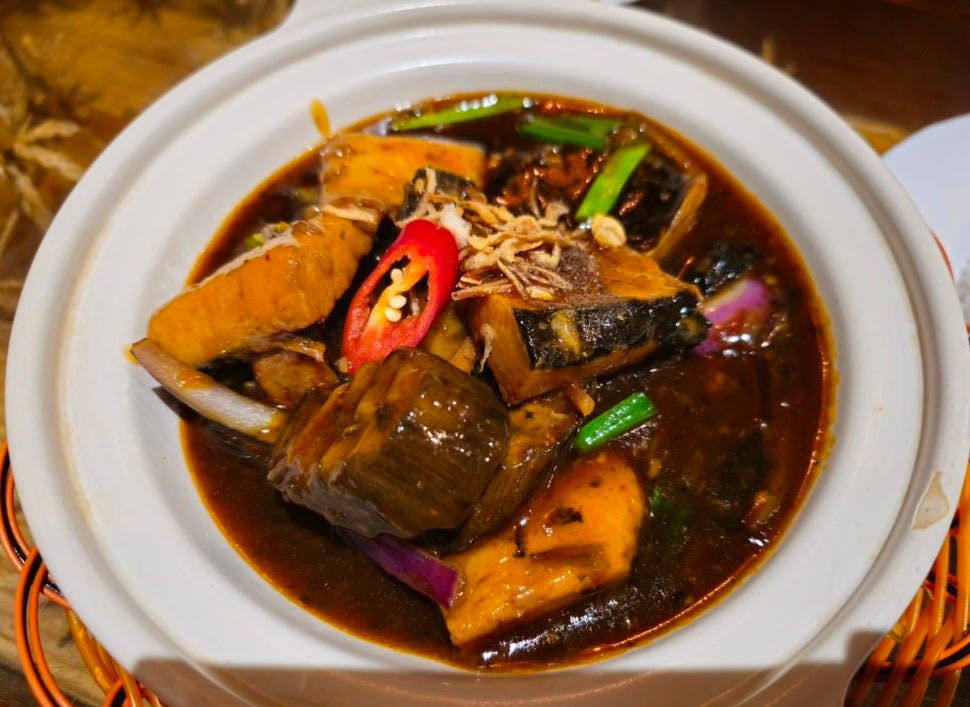
Hà Nội Kho Tộ (Ha Noi Braised Caramel & Banana) (on the top right corner)
Cơm Rang Đặc Biệt (Special Fried Rice) (on the bottom)
Have you had any of these dishes?!
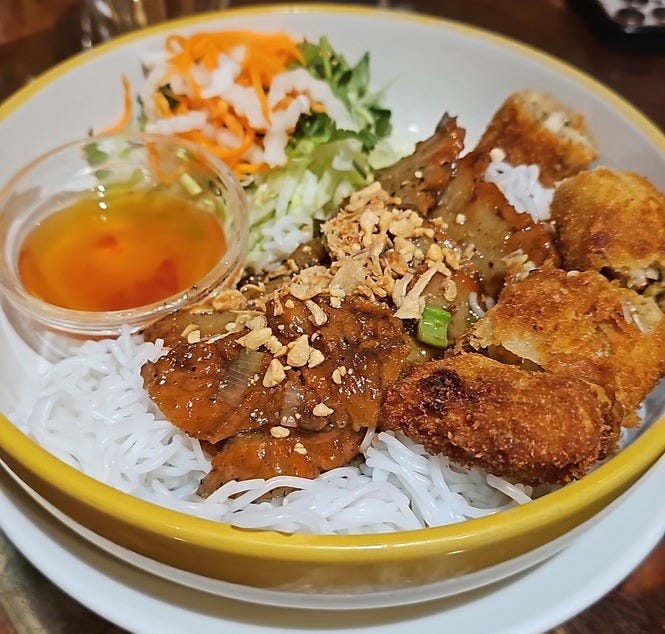
Bún Chả Tổng Thống (Presidential Bun Cha)
The name offers insight into the thinking and humour of the menu creator. They must have adopted the name, borrowing the cultural moment that Barack Obama has brought into one of our national favourites when he visited Hanoi back in 2016 with Anthony Bourdain. It signifies the pride in our food, as being internationally recognised by such an important figure. We are proud of our culinary heritage as much as we are proud of our resilience and the grit that helped us rebuild our nation from the catastrophic wars.
As you look closely, our food always strives to deliver a simple, yet complete meal - a good balance of carbs, protein, and fibre. You will find grilled plant protein and fried spring rolls layered over the rice vermicelli, waiting to be drenched in the sweet and sour sauce.
This is also one of the dishes that I think shouldn’t be hard to mess up. For me, what makes a good bun cha doesn’t lie in the proteins or the noodles, but rather, the dipping sauce is what makes it or breaks it. Nail the tangy-sweet sauce, and you will hit 80% perfection of the dish. Traditionally, it’s grilled over charcoal as the chef can control the char through their fanning technique, a skill that I’m convinced takes time to practice. Though here in the UK, it is typically done in ovens instead.
Hà Nội Kho Tộ (Ha Noi Braised Caramel & Banana)
Cá Kho Tộ (cá means fish) is my soft spot, although the vegetarian version is replaced by soya. This dish carries a significant meaning to my heart. It represents home, both Hanoi and the food that mom makes. When I see Kho Tộ, I can see mom standing next to the stoves, trying to adjust her seasoning as she pours her heart and warmth into her food. It’s not Pho, not Banh Mi, or Bun Bo Hue; it is this dish that cures my homesickness.
Though mom prefers to order takeaway now as it can take lots of time to prepare this dish, and yet, I still can’t find anywhere that makes it as good as hers. It is one of the dishes that you must pair with rice. The light fragrance of steamed jasmine rice diffuses the rich, umami thickness of the sauce and a light spicy note from the chillies, giving you a soothing, savoury taste. The soya and green banana were braised perfectly, just soft enough to absorb the earthy flavours of the sauce.
One thing I love about this restaurant is how much effort they try to translate our cultural cuisine to the eaters. Some descriptions are rather literary - a rare find in any restaurant. It reinforces my point that paying attention to detail is what invites customers back.
Extraordinary ‘course’. You may call it ‘journey’, ‘mon’/gate, or whatsoever other ‘ways’ that our Vegan Saint Chef crafted it out right in you. This awaking traditional Vietnamese food-art brings you the unity of taste and flavour of the sea (seagrass), Earth (soybean, potato starch, sugar, salt), and fire, of course.
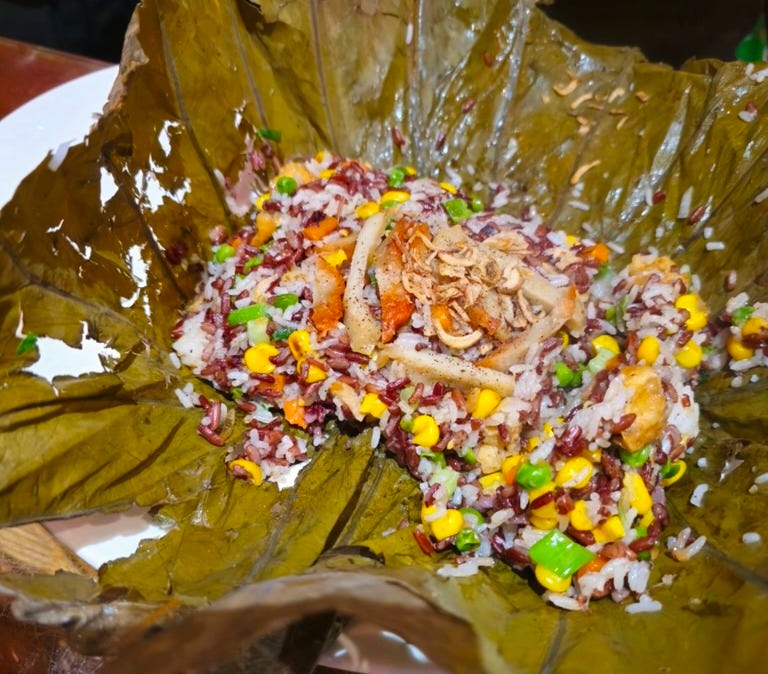
Cơm Rang Đặc Biệt (Special Fried Rice)
Where do I even begin? This is the real definition of “Đặc Biệt”.
Firstly, how many fried rice dishes have you seen that arrive wrapped in a banana leaf? It certainly intrigued us. Just a simple touch can create a huge difference in taste, aroma, presentation, and even the experience.
As you unwrap it, you are instantly hit by the complex fragrance of the fried shallots, riceberry mixed with regular jasmine rice, as the banana leaf imparts a subtle, sweet, earthy aroma when heated.
It is a beautiful scene. The chef must have been satisfied with his art. The burst of colour brings you a sense of excitement as if the dish is waiting for you to begin the hunt.
Just like that, one bite in and you are hooked. Each bite delivers a deep umami flavour as you seek comfort in the food during a winter night. I must say, the taste profile would not have been complete without the banana leaf. You’ll find yourself going back for more.
I can’t end the article without giving credit to the lovely and heartwarming service. Maybe it’s the hospitality of Vietnamese people that is deeply ingrained in every one of us, regardless of where we are across the globe. Surrounded by the old, cultural decorations, a good meal and companionship, and the exchange of our mother tongue with the servers, I felt like I was back in Hanoi for a minute. I still think about that meal.
I hope my friends were left feeling the same. I already look forward to coming back there as I try other dishes, or who knows, I may end up ordering the Hà Nội Kho Tộ again when I long for the flavours of home.
Until next time….
This made me smile, not just because of the delicious-sounding dishes, but because I could feel your joy in sharing a piece of culture, comfort, and home!